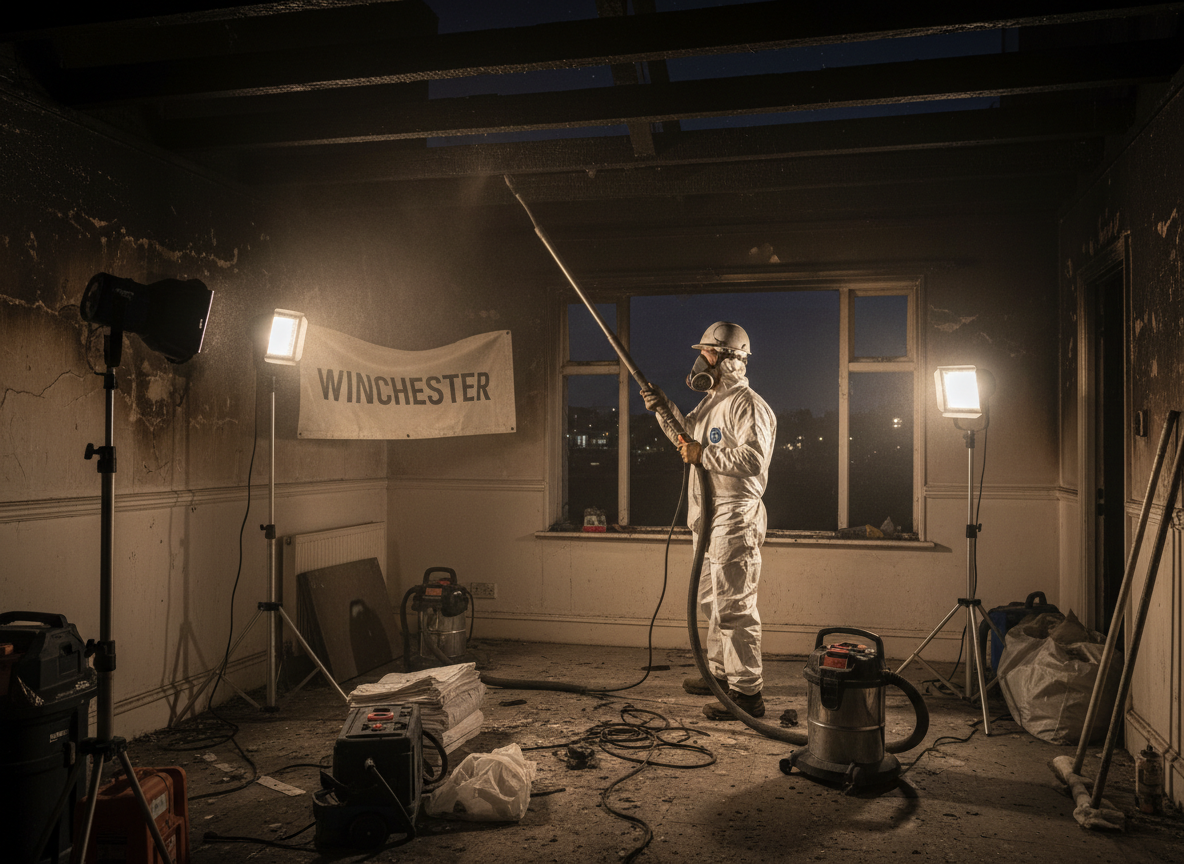
Winchester sits in a hot-summer Mediterranean climate where dry summers and occasional Santa Ana winds can carry embers and soot far beyond the original burn site. Homes in Winchester Hills and Winchester Ranch often feature older wood-frame construction with unsealed attics that allow smoke to penetrate insulation and ductwork quickly. A 24 hour fire restoration crew dispatched from 35952 Winchester Rd must first secure the structure against wind-driven ash while the air is still and before evening winds pick up again.
French Valley properties near Diamond Valley Lake frequently have stucco exteriors over older drywall that traps acidic smoke residues. Delaying extraction allows those residues to etch metal fixtures and HVAC coils, especially when daytime heat accelerates chemical reactions. Technicians begin by isolating unaffected rooms, then use negative-air machines sized for the square footage typical of single-story ranch homes common throughout the area before moving to HEPA vacuuming and odor neutralization.
Riverside County building codes require permits for any electrical or structural repairs after a fire, and local inspectors in Menifee and Hemet expect documentation of moisture readings in wall cavities to rule out hidden water damage from suppression efforts. Crews document every step with photos and moisture logs so homeowners can satisfy insurance requirements without delays. Work continues around the clock until the property passes clearance testing and is safe for re-entry.
Technician insight
In Winchester the thing that catches most people out with 24 hour fire restoration is how fast the dry summer air lets soot set into unsealed stucco and attic insulation in French Valley homes; once it bakes in for even one hot afternoon you end up chasing residue through every wall cavity instead of removing it at the source.
Winchester Ranch Smoke Migration
A kitchen fire in a single-story home sent smoke through the attic into bedrooms. Crews found heavy soot on HVAC filters and inside wall cavities. They ran continuous negative air, extracted residue from ducts, and neutralized odors before the next wind event. The family returned after clearance testing passed.
How it works
- 1
Emergency Board-Up
Secure openings with plywood and tarps to keep wind and animals out of the fire-damaged structure.
- 2
Soot and Ash Removal
HEPA vacuum and wipe all surfaces to remove loose particulates before they embed in porous materials.
- 3
Odor Neutralization
Apply thermal fogging or ozone treatment calibrated for the size of the home and type of smoke residue present.
- 4
Clearance Testing
Independent air sampling confirms smoke and soot levels meet post-fire habitability standards before re-occupancy.
Pricing
Cost depends on square footage affected, smoke penetration depth, and whether structural repairs are required.