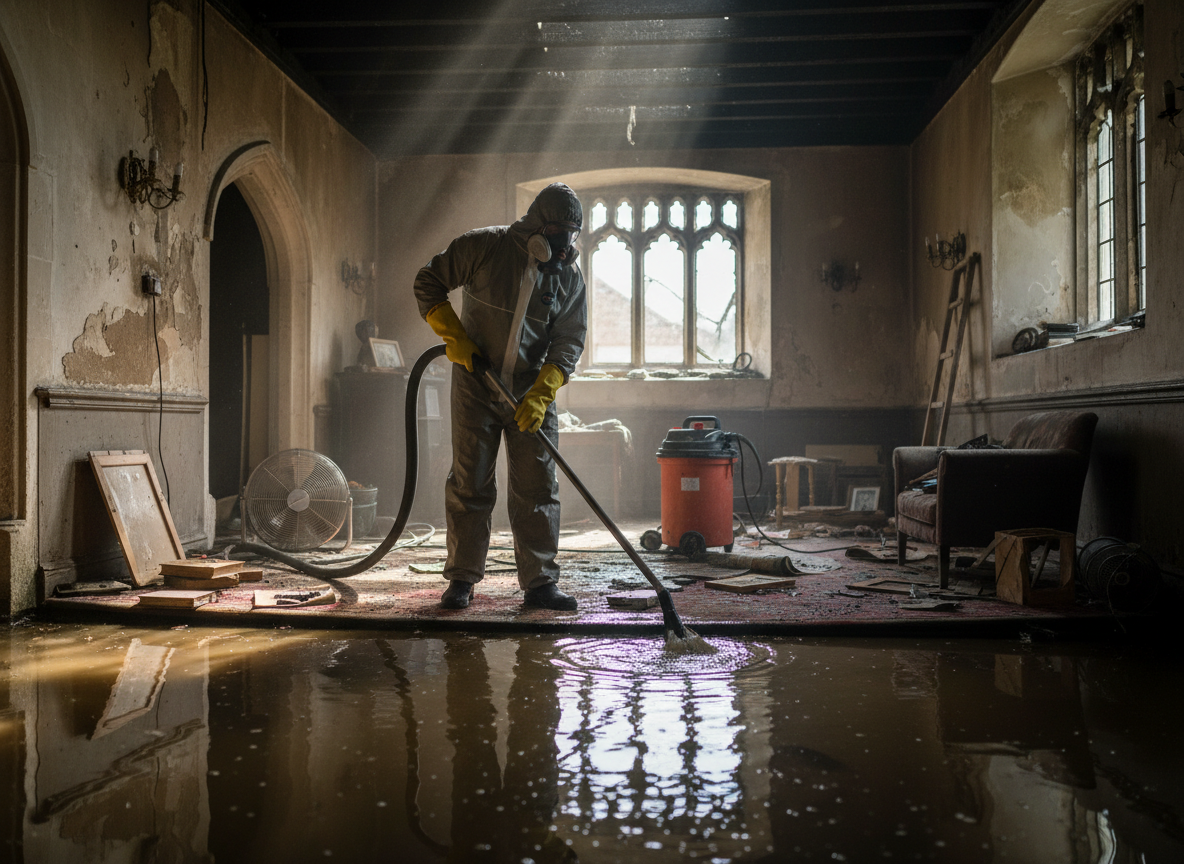
Winchester sits in a hot-summer Mediterranean climate where dry summers and Santa Ana winds push ember intrusion into single-story ranch homes built from the 1970s onward in Winchester Ranch and French Valley. When fire crews extinguish the blaze, residual water often pools in slab-on-grade foundations common throughout Riverside County. Charred drywall and insulation then wick that moisture upward, creating hidden mold colonies behind baseboards within 48 hours if extraction and drying are delayed.
Older homes near Diamond Valley Lake frequently have lath-and-plaster walls and knob-and-tube wiring that complicate soot removal. Floodwater mixed with ash turns alkaline and etches copper pipes and electrical boxes, requiring full isolation of circuits before any drying equipment is placed. Technicians must also watch for expansive clay soils that shift when saturated, cracking already compromised stem walls in Menifee and Hemet border properties.
After initial demolition, negative-air machines with HEPA filtration run continuously because smoke odor travels through shared attic spaces in tract neighborhoods. Dehumidifiers are staged on the concrete slabs for five to seven days while moisture meters track hidden pockets under cabinets and in HVAC returns. Final clearance includes boroscope inspection of wall cavities to confirm no residual water remains before new drywall is hung.
Seasonal Timing
Dry summers increase structure-fire frequency while late-fall rains can re-wet burned homes before repairs finish, extending project timelines by weeks.
Technician insight
In Winchester the thing that catches most people out with Fire and flood restoration is how quickly winter rains re-soak charred framing in older Winchester Ranch homes after the fire department leaves; the clay soils hold that moisture against the foundation and it travels back into the studs if you do not pull base plates and run drying equipment right away.
French Valley Home After Summer Fire and October Rain
Embers entered an attic vent during a dry-season fire, and suppression water collected in the insulation. Two weeks later an early rain soaked the already charred ceiling joists. We removed the wet insulation, extracted hidden moisture from the top plates, and ran drying equipment for six days until readings stabilized, allowing the homeowner to begin reconstruction without further mold growth.
How it works
- 1
On-Site Assessment
Technicians arrive within hours, document smoke and water patterns, and test moisture levels in walls and subfloors of Winchester Hills and French Valley homes.
- 2
Water Extraction and Containment
Standing water is removed and affected rooms are isolated with plastic barriers to prevent soot cross-contamination into unaffected areas.
- 3
Demolition and Odor Removal
Charred materials are removed, followed by HEPA air scrubbing and thermal fogging to neutralize smoke odor embedded in porous surfaces.
- 4
Drying and Monitoring
Industrial dehumidifiers and air movers run until moisture readings return to normal, with daily logs provided to the homeowner.
- 5
Final Clearance
Boroscope checks and air sampling confirm the structure is dry and odor-free before reconstruction begins.
Pricing
Upfront written quotes provided after inspection; final cost depends on square footage affected and hidden moisture discovered during demolition.